

MetaSleuth Alternative: ChainHint vs MetaSleuth for Crypto Investigations (2026)
Honest comparison: both tools trace 12 chains hop-by-hop — the differences are quota models, AI reports, Source of Funds, and who each is built for.

TL;DR: MetaSleuth (by BlockSec) and ChainHint both offer hop-by-hop fund-flow tracing across 12 blockchains — the difference is what surrounds the graph. MetaSleuth is built around a huge label database, quota-metered plans (\(0/\)30/\(100/\)500), and a chart-sharing community. ChainHint is built for incident response: unlimited investigations from $79/mo, an AI-written investigation report included, named Source of Funds analysis, and a freeze-request evidence packet for lawyers and victims. All facts below are current as of August 2026 and linked to primary sources.
The chain-count question, answered first
Marketing pages love big chain numbers, so let's be precise about both products.
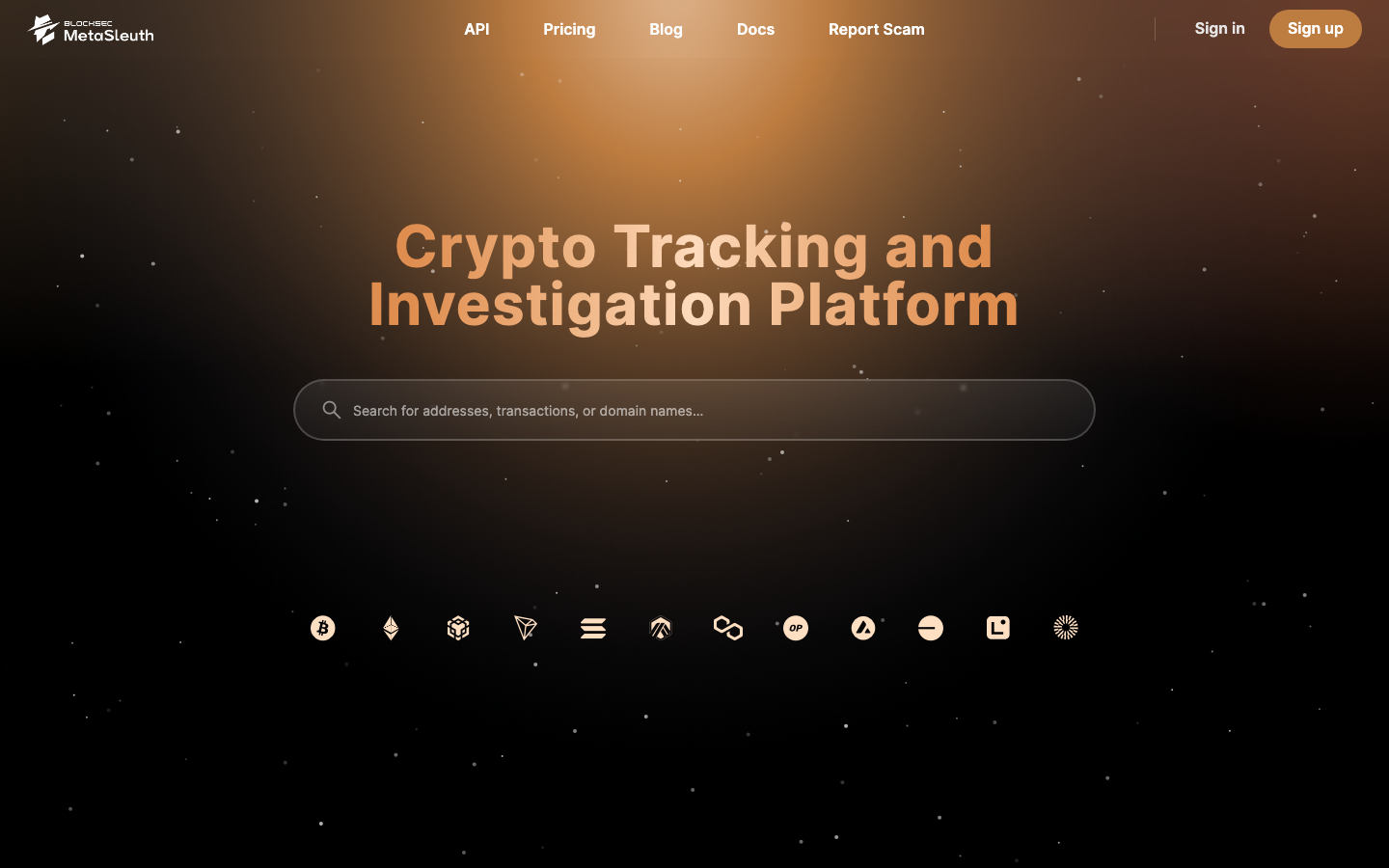
MetaSleuth traces 12 chains. Its fund-flow graph covers Bitcoin, Ethereum, BNB Chain, TRON, Solana, Arbitrum, Polygon, Optimism, Avalanche, Base, Linea, and Mantle (their docs). The "25+ chains" figure you'll see elsewhere refers to their Address Label API — a lookup service that returns labels for an address but does not trace funds. Their Risk Score API analyzes "only the target address and its one-hop related addresses" (their wording), with full interaction risk available on 12 of 26 networks.
ChainHint traces 12 chains. Ethereum, Bitcoin, BNB Chain (BSC), Polygon, Arbitrum, Optimism, Base, Avalanche, Gnosis, Solana, TON, and Tron (beta) — all with full hop-by-hop tracing, on every plan including Free.
So the honest headline is: the two tools have the same tracing breadth, with a different mix. MetaSleuth uniquely covers Linea and Mantle; ChainHint uniquely covers Gnosis and TON. If your case lives on one of those four chains, that alone decides the comparison.
This screening-vs-tracing distinction applies across the whole industry: when a vendor says "supports N chains", ask whether that means look up an address or follow the money. The numbers are usually not the same.
Quick comparison
| ChainHint | MetaSleuth | |
|---|---|---|
| Hop-by-hop tracing | 12 chains (incl. Gnosis, TON) | 12 chains (incl. Linea, Mantle) |
| Label/screening coverage | 54M+ labeled addresses, 3.9M+ known entities | "600M+ address labels" advertised (300M+ elsewhere on the same site); entity count not published |
| Pricing model | Plan depth: addresses per trace + hop depth | Quota counters: N investigations, N analyses, N exports per month |
| Free tier | 1 investigation, 50 addresses, 3 hops, all 12 chains | 200 basic investigations/mo, 1 monitored address, watermarked charts |
| Paid entry | $79/mo (Investigator): unlimited investigations, 500 addresses, 4 hops | \(30/mo (Basic): higher quotas; \)100/mo (Pro) removes watermark |
| Top tier | $499/mo (Agency): 2,000 addresses, 6 hops, API included | $500/mo (Ultra): unlimited quotas, aimed at law enforcement |
| AI investigation report | Included (Investigator+), narrative + recommended next steps | Separate consumer product (Trace AI): \(5/trace, \)100/full report, 8 chains, "coming soon" as of Aug 2026 |
| AML / source analysis | Source of Funds: named senders per address | Risk Score API: one-hop exposure only |
| Monitoring | 5 addresses (Investigator) / 50 (Agency), in-app + email | 9 chains, email only, 1 address on Free |
| API | Wallet Reputation API included in Agency ($499/mo) | Label API \(599/mo, Risk API \)499/mo — sold separately from plans |
| Payment | Crypto via NOWPayments, no auto-renewal | Card and crypto |
Sources: metasleuth.io/plans, docs.metasleuth.io, chainhint.com/pricing. MetaSleuth figures verified 2026-08-28.
Different DNA: research platform vs incident response
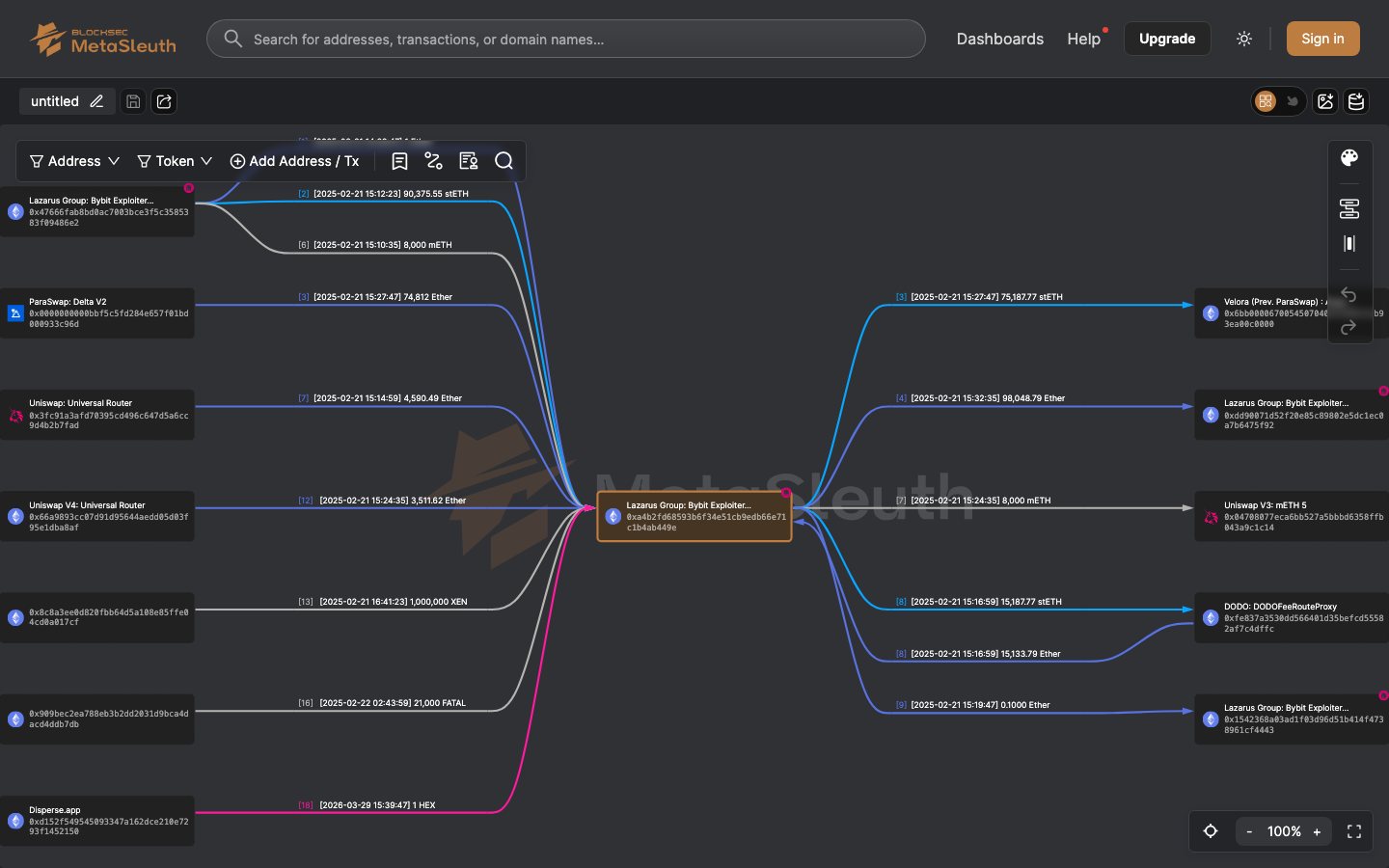
MetaSleuth grew out of BlockSec's security research. Its strengths reflect that: an enormous label database, a polished canvas for building and annotating fund-flow charts, an InterChain Tracker that auto-detects bridge hops, and a sharing culture — crypto-Twitter investigators publish MetaSleuth charts the way analysts publish spreadsheets. Its tier ladder runs from hobbyist DYOR ($0–30) up to "law enforcement and investigative agencies" (Ultra, $500/mo).
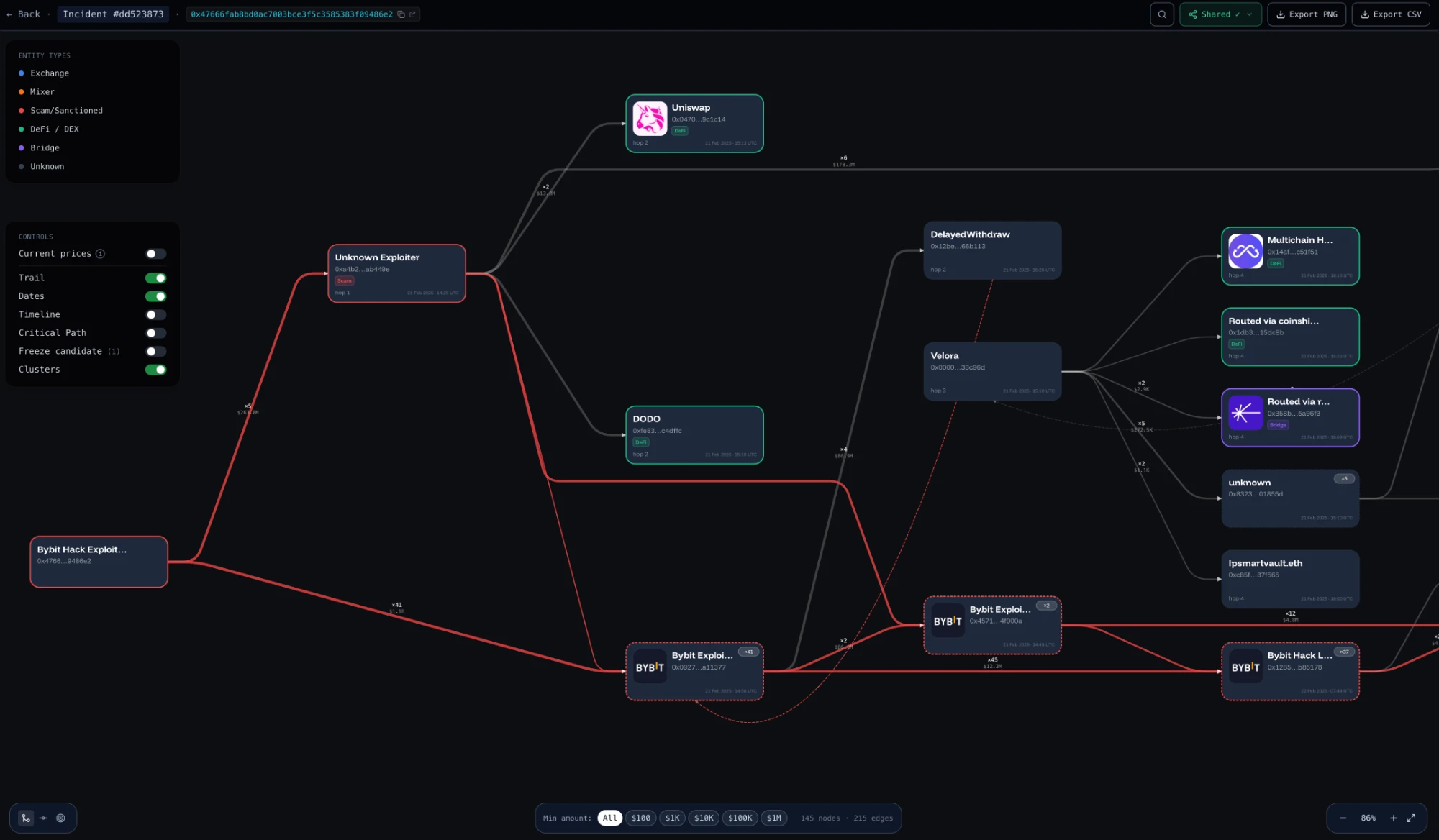
ChainHint is built for the first 24 hours after a theft. Paste the address, get the full picture in about a minute: the fund-flow graph, entity attribution, sanctions status, risk scoring — and then the parts MetaSleuth doesn't do: an AI-written investigation report that explains where the money went in plain language, which exchanges received it, and what to do next; a Source of Funds view that names who funded any address; and a freeze-request evidence packet formatted for exchange compliance teams and law enforcement.
The quota models express the same difference. MetaSleuth meters actions: even CSV export is counted (5/month on Free), and "Advanced Analysis" runs are a monthly quota on every tier below Ultra. ChainHint meters scale: how many addresses one trace may expand to (50 → 500 → 2,000) and how deep it goes (3 → 4 → 6 hops) — but from Investigator up, the number of investigations is unlimited. If your month involves one huge case, ChainHint's model fits. If it involves two hundred small lookups, MetaSleuth's might.
When MetaSleuth is the better choice
Honesty over marketing — pick MetaSleuth if:
Your case is on Linea or Mantle — ChainHint doesn't trace those chains.
You need the largest possible label coverage for exploratory research; their advertised label base is an order of magnitude larger than ChainHint's (with the caveat that its unit of counting isn't published).
You want a chart-building canvas for public attribution threads — the memo/share workflow is the community standard on crypto Twitter.
\(30/month fits your budget better than \)79 and you can live inside the monthly quotas and watermark.
When ChainHint is the better choice
Pick ChainHint if:
You're a victim, lawyer, or first responder and need a complete, explained picture fast — not a canvas to build one manually. The AI report is included, not a $100 add-on.
Your case touches Gnosis, TON, or Tron (Tron in beta) — or you want all 12 chains available on the Free tier before paying anything.
You need Source of Funds — named senders behind an address, not a one-hop risk score.
You need evidence output: PDF reports, and on Agency a freeze-request packet built for exchange compliance and law enforcement submissions.
You want API access without a separate contract — the Wallet Reputation API (10,000 req/day) is part of the $499 Agency plan; MetaSleuth prices its Risk API alone at $499/mo on top of a subscription.
You prefer crypto payment with no auto-renewal — plans are prepaid and simply expire; nothing to cancel.
FAQ
Is MetaSleuth free?
MetaSleuth has a free tier with 200 basic investigations per month, 1 monitored address, and watermarked charts; advanced analysis and exports are tightly quota-limited. ChainHint's free tier is one full investigation (50 addresses, 3 hops) with the fund-flow graph, on any of its 12 chains.
How many chains does MetaSleuth support?
12 chains for fund-flow tracing (Bitcoin, Ethereum, BNB Chain, TRON, Solana, Arbitrum, Polygon, Optimism, Avalanche, Base, Linea, Mantle). The "25+" number refers to its address-label lookup API, which does not trace funds.
Can either tool recover stolen crypto?
No tool can. Both trace where funds went; recovery happens when exchanges, issuers, courts, or law enforcement act on that evidence. ChainHint packages the evidence for exactly that handoff. Be wary of any service promising recovery for an upfront fee.
Do ChainHint and MetaSleuth trace across chains?
Both detect bridge transfers. MetaSleuth's InterChain Tracker auto-follows a set of known bridges; ChainHint annotates the bridge and destination chain and continues the trace there as a linked investigation.
ChainHint is a blockchain forensics platform for incident response and crypto investigation. 54M+ labeled addresses, 3.9M+ known entities, 12 chains with full hop-by-hop tracing. From $0 — chainhint.com. MetaSleuth facts verified against metasleuth.io and docs.metasleuth.io on 2026-08-28; if you spot something outdated, tell us and we'll fix it.


